Decibel #10
Here’s some things from around the internet I consumed this week and found interesting:
by the vlogbrothers (4 min video) 2. [Cargo Cult Science](https://calteches.library.caltech.edu/51/2/CargoCult.htm) by Richard Feynman (transcript of Caltech’s 1974 commencement address) 3. [Keep Your Identity Small](http://www.paulgraham.com/identity.html) by Paul Graham (short essay)Below, find some of my thoughts.
1. Commit to the Bit
by the vlogbrothersI’m wouldn’t say I often “do a bit” but I do find them quite amusing.
A good friend of mine had an excellent bit where they (with permission) decided to trick the incoming freshman that he was another one of our friends for an entire semester while the other was studying abroad. The best part was that a larger social friend group also needed to commit to the bit for it to work, so a large part of the success was the imposter convincing everyone to actually go along with it.
2. Cargo Cult Science by Richard Feynman
I enjoy how measured Feynman is in his approach to science. He explains things clearly but still with excitement, with a genuine joy of learning things that is invigorating. This piece on Cargo Cult Science is no exception. It explores what it means to learn about the world and how to not be fooled.
I think the educational and psychological studies I mentioned are examples of what I would like to call Cargo Cult Science. In the South Seas there is a Cargo Cult of people. During the war they saw airplanes land with lots of good materials, and they want the same thing to happen now. So they’ve arranged to make things like runways, to put fires along the sides of the runways, to make a wooden hut for a man to sit in, with two wooden pieces on his head like headphones and bars of bamboo sticking out like antennas—he’s the controller—and they wait for the airplanes to land. They’re doing everything right. The form is perfect. It looks exactly the way it looked before. But it doesn’t work. No airplanes land. So I call these things Cargo Cult Science, because they follow all the apparent precepts and forms of scientific investigation, but they’re missing something essential, because the planes don’t land.
It’s important to be able to recognize when things look like science to be able to determine if they are good science or Cargo Cult Science. I haven’t come across this term before, but I rather enjoy it. It has the form without having the substance. As someone who has a liking towards a science-y way of thinking, it’s good to remind myself that things that have the form of science might actually hold truth. In fact, it takes a discerning eye to learn real things about the world.
The first principle is that you must not fool yourself—and you are the easiest person to fool. So you have to be very careful about that. After you’ve not fooled yourself, it’s easy not to fool other scientists. You just have to be honest in a conventional way after that.
I love the way Feynman describes just being conventionally honest here. If you’ve explored something well enough that you can convince yourself you haven’t been fooled, then you don’t have to play any games or dance around anything when explaining how something works.
Feynman then points to helpful clues for making sure you aren’t following the “cargo cult science”:
In summary, the idea is to try to give *all* of the information to help others to judge the value of your contribution; not just the information that leads to judgment in one particular direction or another.
And accordingly, be suspicious when you don’t see the evidence against something as well! If you only see the supporting evidence, not all of the evidence, be aware. It could still be solid, but I find it helpful to have flags to look for. Little markers that clue my brain into checking if there is more information under the covers.
So I wish to you—I have no more time, so I have just one wish for you—the good luck to be somewhere where you are free to maintain the kind of integrity I have described, and where you do not feel forced by a need to maintain your position in the organization, or financial support, or so on, to lose your integrity. May you have that freedom.
I encourage you to read the whole piece, I found it worth my while.
3. Keep Your Identity Small by Paul Graham
From the title I thought this piece would be about keeping a small online profile. That is not what this essay is about.
Instead it’s about when opinion become identity.
As a rule, any mention of religion on an online forum degenerates into a religious argument. Why? Why does this happen with religion and not with Javascript or baking or other topics people talk about on forums?
I think what religion and politics have in common is that they become part of people’s identity, and people can never have a fruitful argument about something that’s part of their identity. By definition they’re partisan.
While I think Paul is directionally right here, I will add the nuance that people can and do have fruitful arguments about something that’s part of their identity; it takes a certain strength of character to not take things personally. To be able to step back and have a thoughtful discussions of your beliefs, even ones you hold dear to your identity, is a healthy and useful skill to develop. A stoicism of sorts, if you will.
The most intriguing thing about this theory, if it’s right, is that it explains not merely which kinds of discussions to avoid, but how to have better ideas. If people can’t think clearly about anything that has become part of their identity, then all other things being equal, the best plan is to let as few things into your identity as possible.
I’m torn here. The logic seems to flow correctly, but I can’t help but feel that there is a better main takeaway here. “All other things being equal” doesn’t have to hold. Why not learn to think more clearly about your own identity? Shouldn’t we endeavor to improve our own thinking?
I’m reminded of a Q&A with the YouTuber CGP Grey on the importance of being able to change your mind:
The trick is to keep your identity separate from your opinions — they are objects in a box you carry with you and should be easily replaceable if it turns out they’re no good.
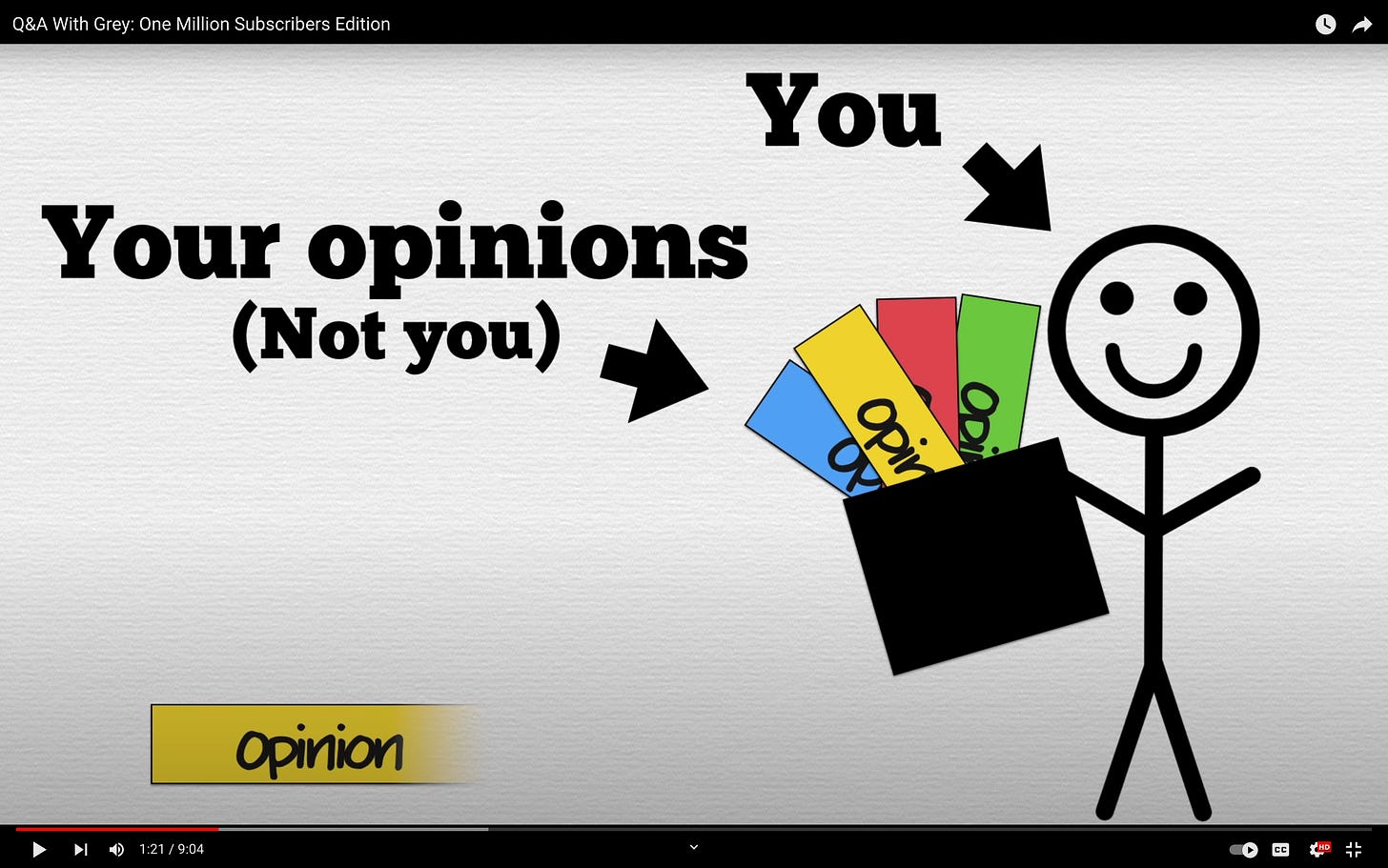
If you think that the opinions in the box are *who you are* then you’ll cling to them despite any evidence to the contrary. Bottom line: If you want to always be right, you need to always be prepared to change your mind**.**
Opinions are different from identity, but they certainly blur together (especially religion and moral opinion). Keeping your opinions in a box is similar to Paul’s recommendation of keeping your identity small, but I directionally prefer the idea of opinions in a box.
Or better yet, maybe a hat. You can be the guy always wearing the red hat (which I think works well as a metaphor for opinion strong enough to become identity), but if you need to, you can take it off and take a look at it, talk about the hat thoughtfully with your friends, then choose to put it back on, give it a wash, or get a completely new one.
Anyways, Paul Graham’s essay was thought provoking as usual, and for that I’m grateful.
RSS also available.